
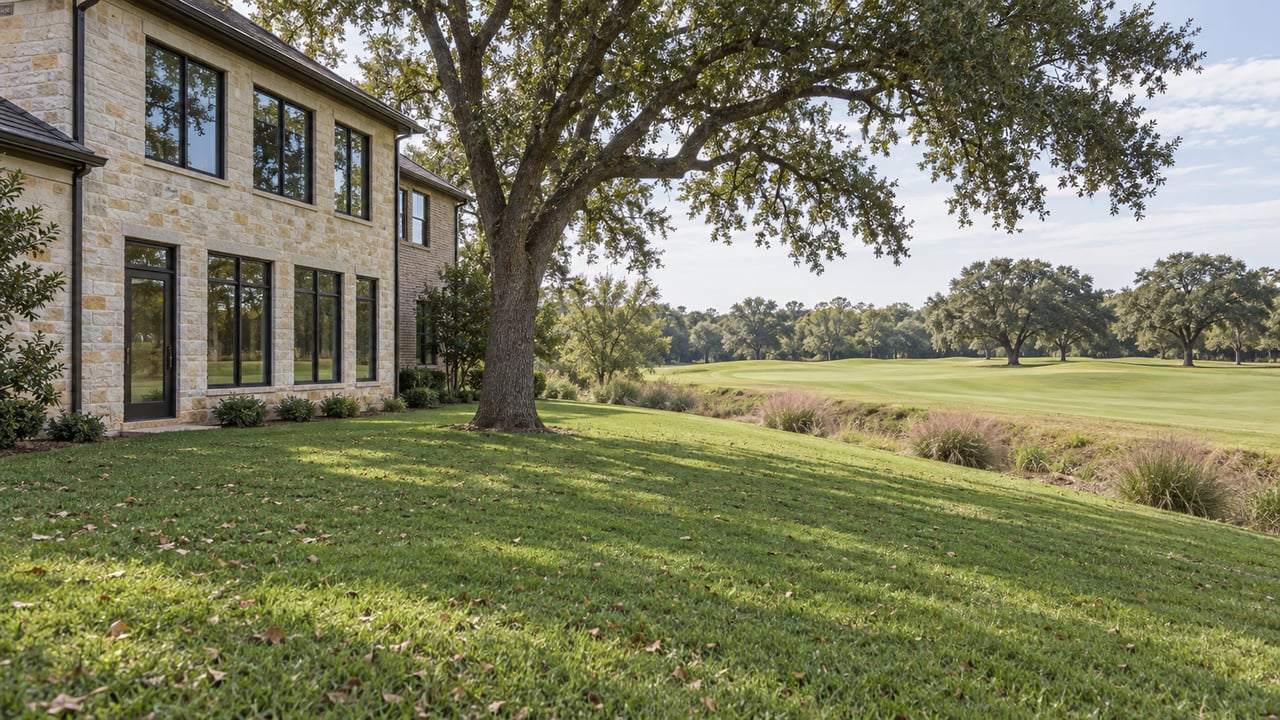
Buyers shopping golf-course lots in Flower Mound tend to price the view the same way no matter which course sits behind the fence. Mature trees, a strip of green, the occasional cart rolling past at dusk. At Tour 18, that view rests on a different foundation than it does at a member-funded course two miles away, and the difference only shows up once you own the lot and start watching the fairway change with the seasons.
Tour 18 Dallas opened in 1995, three years after its Houston sibling introduced the idea of a golf course built entirely from replicas of famous holes. Architect David D. Edsall laid out 7,033 yards that recreate the island green at TPC Sawgrass on the ninth, the Church Pew bunkers from Oakmont on the tenth, Riviera's par-3 sixth on the twelfth, and a closing stretch modeled on Augusta National's Amen Corner. The address, 8718 Amen Corner, comes straight from that finish. Some of the original clubs pushed back hard enough on the accuracy of the copies that concessions had to be made, including the removal of a replica lighthouse behind the Harbour Town-style eighteenth. That novelty, playing holes most golfers will never see in person, is why builders started selling fairway lots at a premium when construction on the Estates at Tour 18 began in 1994. The neighborhood is planned for roughly 175 homes at full build-out, on lots running 1.5 to 2.5 acres, wrapped around a course built to be looked at as much as played.
Public Course, Private Homes
Here's the part that gets lost in the listing photos. Tour 18 is a public, daily-fee golf course. Anyone can book a tee time and pay the posted rate, which currently runs from around $125 to $149 depending on the day and time. Nobody living in the Estates at Tour 18 pays dues that fund the turf program. The neighborhood HOA governs the gate, the streets, and the architectural committee. It has no line item for irrigation or drainage on the golf course itself, because the HOA never owned that asset and never will.
Compare that to a private, member-funded course like Lantana Golf Club, listed by Golf Digest as a private facility. There, the maintenance budget is funded by member dues, and a meaningful share of those members live on the course they're paying to maintain. If the fairways start going brown, someone with a vote and a mortgage nearby is asking about it at the next meeting. At Tour 18, the equivalent lever is green-fee volume and whatever pricing decision the operator makes that quarter. General Manager Dan Haag runs day-to-day operations, but the budget is built around golfer traffic and green fees rather than resident assessments.
What Recent Player Reviews Say
Player reviews of Tour 18 are mixed. Some golfers praise the layout, the greens, and the pace of play, while others describe stretches of uneven conditions. One reviewer described the fairways as basically dead on a day when the round still cost north of $100. Another described a failed irrigation pump that left the crew watering greens only, with fairways and tee boxes going dead, bunkers worn down to exposed concrete, and burst water pipes sitting in the rough. A more recent account describes ongoing bunker work with holes left open and unmarked, cart GPS pin locations that didn't match the actual flag position, and tee box readings that didn't line up with where the tee boxes actually were. That same reviewer noted the course has changed hands more than once since an earlier visit, though that detail comes from a player's account rather than a public ownership filing, so it's worth treating as color rather than confirmed record.
Even in reviews that criticize fairway conditions, golfers often describe the greens as being in good shape. For a homeowner, that split matters because the fairways are the part of the course visible from the back porch. Every course sets maintenance priorities within its own budget, and at Tour 18 those priorities are set by the operator rather than by the neighbors.
Why the HOA Can't Write a Check for This
This is the structural gap a fairway lot buyer needs to understand before falling for the view in a listing photo. The HOA that governs the Estates at Tour 18 can enforce paint colors, fence height, and architectural review. It cannot direct a dollar toward turf reseeding, cannot vote on an irrigation upgrade, and has no seat at whatever table decides how the course gets maintained this season. That authority sits entirely with the golf operation, which answers to green-fee revenue and whoever holds the operating lease or ownership at a given time.
| Tour 18 (public, daily-fee) | Member-funded course (e.g., Lantana Golf Club) | |
|---|---|---|
| Course ownership | Independent operator | Club/member entity |
| Who funds the turf program | Green-fee revenue | Member dues |
| Who has a vote when conditions slip | No one adjacent | Members, many living on-course |
| How a budget shortfall is handled | Decided by the operator | Special assessment or budget debate |
This isn't an argument against buying near Tour 18. It's a reason to price the view differently than you'd price one at a course where the people living next to it also fund its upkeep.
What to Actually Check Before You Write an Offer on a Fairway Lot
A few things are worth confirming before that view becomes part of your monthly view rather than a photo you toured once.
- Ask which hole the lot backs up to. The Amen Corner replica holes near the finish tend to see heavier play and more visible traffic than a lot along the front nine.
- Request the HOA's resale certificate and confirm exactly what it covers. It will speak to neighborhood infrastructure and assessments, not to golf course conditions, and knowing that in advance avoids a surprise later.
- Ask the listing agent or seller whether the course has had any recent closures or maintenance disruptions, including irrigation issues, since that history affects both showing conditions and how the view will actually look across a full season.
- Walk the property line at different times of year if you can. Overseeding schedules and seasonal dormancy change how a Bermuda fairway looks in January versus July, independent of any maintenance problems.
- Compare the price per square foot against a similar interior lot in the same section of the Estates at Tour 18. That gap is the actual dollar figure you're paying for the view, and it's worth deciding whether that premium holds up given how much of the view's condition sits outside anyone's control who lives there.
The lot behind the ninth green will always look the same in the listing photos. Whether it looks that way in July depends on the operator's maintenance program, which sits outside the neighborhood's governance.
If you're weighing a fairway lot in Tour 18 against something with a different amenity structure, the North Texas Team can walk you through what each option actually commits you to before you write an offer.